
No Kings, No Costs
Notes from the Capital

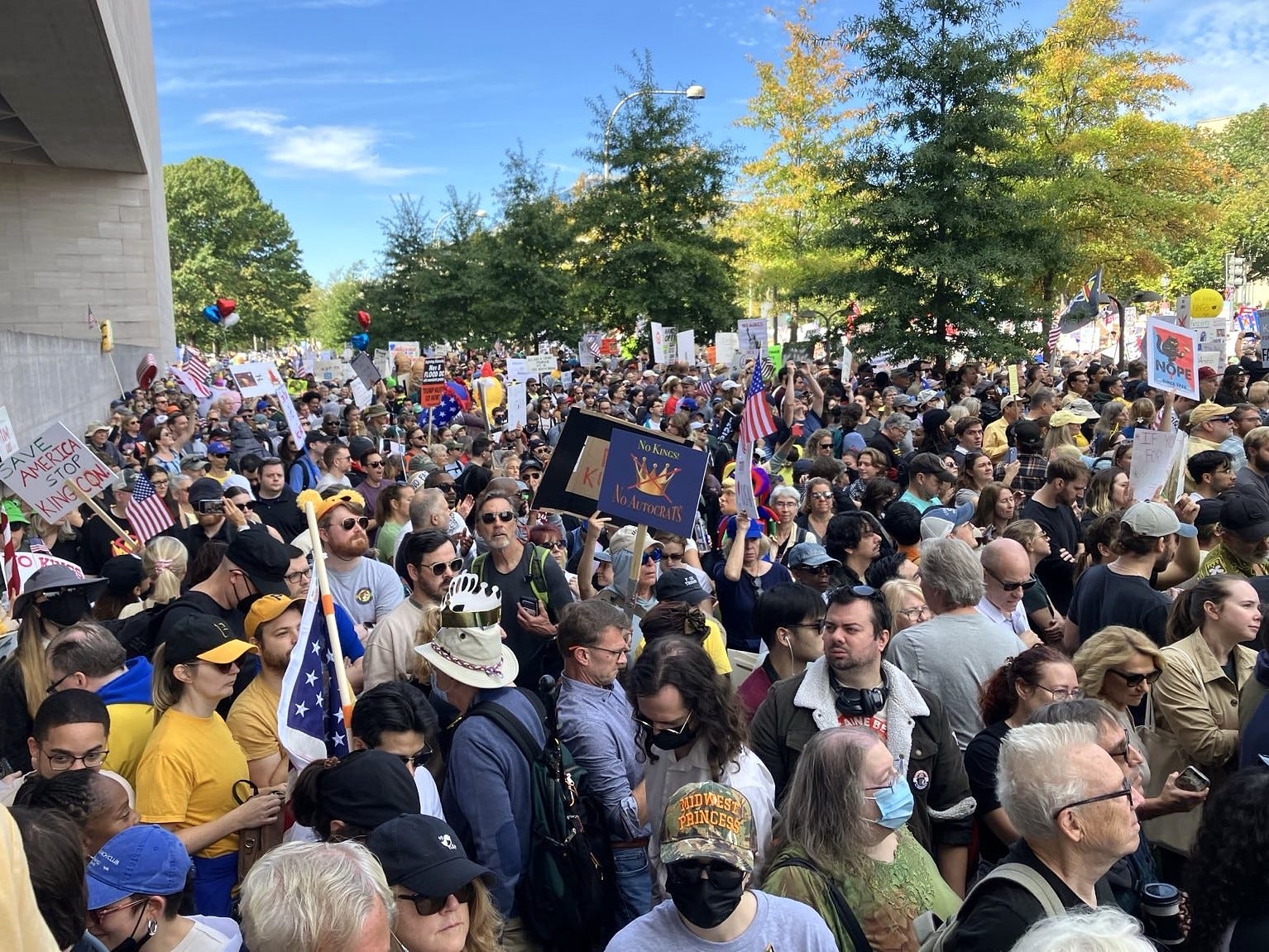
Last Saturday I attended the No Kings demonstration in downtown Washington, DC near the Capitol. I’ve read much in the past week about how inspiring people found the protests (across the country). And, as a longtime advocate and sometime professional implementer of democracy and rule of law, I was certainly moved. But as a lifelong analyst in one shape or another, I can’t help but step back and evaluate the protests as part of a long term resistance campaign.
No Kings October certainly hit the obvious markers for a successful demonstration. It was huge, probably the second-largest DC protest of the past decade. It was wildly peaceful—not so much as a cross word to be heard. Perhaps it was the grownups wearing self-inflating frog, giraffe, and unicorn costumes. Or perhaps it was the fact that the rally was not anywhere near the White House—I’m not sure what was behind the choice to hold it closer to the Capitol, given that it was explicitly a protest of the president, but whether intentional or not, it significantly reduced the tension.
So far, No Kings has checked two boxes that social scientists associate with successful protest movements: size and nonviolent tactics. But as we go further down that list, some things give me pause.
The Un-Gen-Z Protest
For one, the protesters were enthusiastic, but they were also old. So-called Gen-Z protests have erupted around the world (though concentrated in Africa and South Asia) driven by young people’s rage at corruption and repression and abysmal delivery of public goods. Those same grievances seem to have energized Gen X and Boomers, perhaps some Millennials, but very few Gen Z. I would estimate the median age somewhere in the low 40s, with far more protestors above 55 than below 25. Usually, the appearance of older, middle class participants signals a positive shift in the prospects of a protest campaign, but that is because protests historically are much more likely to be instigated by college-aged people. Old folks showing up suggest that grievances are broadening and mobilizing more than the usual suspects. But here in DC, at least, the youth are absent from the outset.
The NPR Protest
Moreover, it was exceedingly White. About 43 percent of DC’s residents are Black, and about 26 percent of the surrounding suburbs, yet I would guess the share of Black protestors in DC didn’t even reach two percent on Saturday. Why didn’t Black Washingtonians show up? Are they not concerned? Or did the No Kings organizers not engage with Black civil society? Skimming the list of almost 300 partner organizations, I notice many groups representing various identities—Jews, Catholics, Latinas, Women, but very few representing Black Americans. No Kings is missing a critical constituency of the left, and will need to figure out why if they want to maximize their potential.
In sum, the DC demonstration on Saturday looked exactly like David Brooks’ recent epithet: “[l]arge anti-Trump rallies attended exclusively by NPR listeners in blue cities...” Of course, the No Kings protests weren’t relegated to blue cities. But in DC they did look an awful lot like NPR listeners. This matters because diversity is a third critical characteristic of successful protest campaigns. Social science research finds that movements last longer, are more resilient to repression, and more likely to achieve success when participants come from all walks of life.[1] No Kings’ NPR march in DC was a pretty dismal showing on this front.
The Kitchen Sink Protest
Another key characteristic of successful campaigns is a limited set of specific demands. Soaring rhetoric covering a broad list of grievances may get the people to bang their drums, but at some point they need a focal point, and their targets (usually government leadership) needs to know what is being demanded of them. Without specific demands, there is no pressure for any real action. The demands can, and often do, change over time. The vast majority of uprisings that overthrow regimes, for instance, start with more modest demands and over time escalate to calls to remove the leader. Ukraine’s Maidan uprising, known as the Revolution of Dignity, started as a protest over President Yanukovych’s abrogation of an impending agreement with the EU; a month later, as the movement weathered increasingly violent repression, it was united in demanding the president’s ouster.
DC’s No Kings was an illustration of the difficulties of focusing a big-tent movement. The crowd was broadly united in deriding Trump, but the specific grievances were quite varied. Signs calling for releasing the Epstein files, dissolving ICE, and redeploying the National Guard swam in the crowds with Palestinian flags, Ukrainian flags, Pride flags, and frog cosplay. There is a natural tension here—reaching size and diversity is more likely when there are a broader set of grievances at play, and diverse crowds are less likely to agree to a single focal point.
The Party’s Protest
Of the roughly eight speakers at the main stage, three were Democratic senators (for simplicity’s sake, let’s call Bernie Sanders a Democrat). Sanders spoke last and while it was fairly rousing, it was a typical stump speech. He called for stronger worker protections, expanding voting rights, and a national recommitment to economic and political justice. He denounced economic inequality and Trump’s slashing of Medicaid and ACA budgets, and vowed to continue voting no on the budget bill until healthcare funding is restored.
All fair points, but it sounded like any other speech I’ve heard him deliver. It did not feel like a singular moment in time. It did not feel like a call to action. In aggregate, the speeches felt like a catalog of complaints. This is part of Trump’s political advantage—he has transgressed in so many different arenas, he confounds any attempt to wrap all the complaints into a single message.
Politicians are obvious participants in political demonstrations because they are practiced public speakers, strongly associated with the issue at hand, and bring their own constituencies. But they also—by their very identity, regardless of their words—turn political events into partisan events. And partisanship brings baggage. It narrows the doorway through which Americans writ large might enter the domain. It discourages conservatives who might have turned away from Trump’s Republican Party but bristle at the Democratic counterparts; liberals who loathe Trump but are fed up with their party; independents who are looking for something that transcends dirty politics.
This is why successful resistance movements are rarely led by parties or politicians, from the American Civil Rights movement to the Gen-Z movements that seem to be ejecting leaders left and right these days.
No Kings, 50501, and the other anti-Trump groups that have sprung up in the past year, are going to have to choose whether they are a resistance movement or a party megaphone.
There is no shame in being a party megaphone, to be clear. Particularly since the single most important task having to do with opposing Donald Trump is for Democrats to win at least one chamber of Congress in 2026, while there is still a semblance of fairness to elections. But partisan victory is a more modest goal, with shorter-term payoffs and smaller margins, than sociopolitical change. If No Kings wants to be more than a turnout operation for Democrats, it needs to cultivate an identity distinct from the party apparatus.
The Nice Protest
Perhaps most concerning was how unthreatening the entire affair felt. Peaceful protests are critical to maximizing chances of achieving objectives, but protests have to generate some degree of tension, otherwise they are too easy to ignore.
If the peaceful nature of the protests were striking, so was the muted response from the administration. Silly and gross AI videos notwithstanding, the White House response was nicely summarized by a spokesperson: “Who cares?” I saw no federal agency officers on the streets, nor any National Guard troops. The most ominous police presence was by the countersniper team on the roof of the Smithsonian Museum of Modern Art, but most protestors did not seem to notice them.
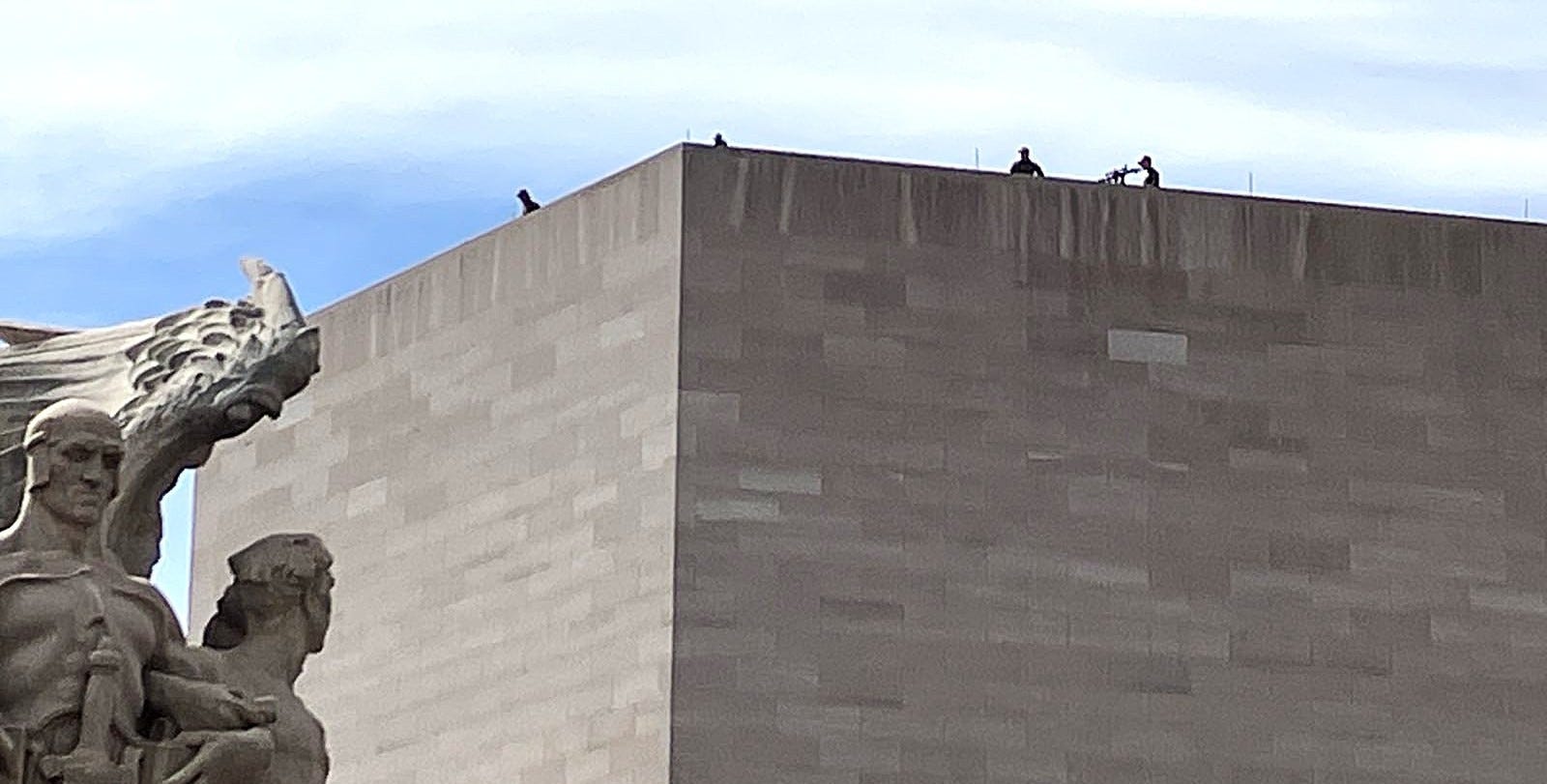
Donald Trump is not someone who typically responds to challenges with nonchalance, so the mild dismissal tells me he truly is not worried. According to Christian Davenport’s Law of Coercive Responsiveness, when citizens engage in dissent or resistance, states tend to respond with repression in proportion to the perceived challenge. And Trump has been paving the way for imposing pretty harsh repression, repeatedly alluding to the Insurrection Act as the basis for it. So if Trump sits on his hands, it tells me he does not (at least yet) see the protests as a threat.
Way(s) Forward
Ultimately, protest movements become threats when they impose a cost on the leader. A gathering of dissatisfied people, no matter how large, does not by itself impose a cost. Ridiculing the president does not impose a cost (that is not to say making him look foolish does not, but that’s not the same thing).
How to impose costs on Donald Trump? One idea would be to temporarily focus all civic action, including protests, on a single demand that everyone could get behind and that Trump could realistically concede to. An obvious choice would be the government shutdown. (While nominally a congressional issue, I believe the entire country—blue, red, and purple—understands Trump has near total command of Republican congressional leadership—and thus could end the shutdown at will.) The simple fact of massive protests against Trump for the shutdown would underscore Trump’s accountability for the debacle. If Trump was forced to concede, it would be a minor humiliation for him as well as a public good for the country; if he refused, he would accrue increased blame for the standoff and its ills.
Another idea would be to try to undermine the support on which Trump relies for his executive expansion. For instance, why not have nationwide demonstrations aimed at individual senators and representatives who have supported Trump? With such tight margins, Trump could be hamstrung by any more than a few defections, and make it more difficult for Speaker Johnson to play ball with every move. We’ve seen the ire many Republican face from their constituents at town halls, so why wait for them to hold town halls?
Or demonstrations could occur at the corporate headquarters of those companies most closely aligned with Trump. One could start with those who donated to the replacement of the East Wing with a ballroom—Alphabet, Amazon, Apple, Microsoft, Meta, Palantir, and Lockheed Martin most prominently (see full list here). Boycotts are the typical civil action against companies, but why not take advantage of this level of enthusiasm for protesting and establish a physical presence at these companies? Perhaps that could call attention to a follow-up boycott or disinvestment campaign.
Regardless, No Kings, 50501, and other groups are going to have to determine how to move beyond feel-good rallies if they are going to move the needle. This is not to discount what they have accomplished. Mobilizing eight million people in hundreds of locations nationwide is a jaw-dropping feat. But dropped jaws by themselves do not change anything.
More specifically, movements that do not threaten power do not change the course of politics. The administration’s yawning response should be a wake-up call. If No Kings wants to be more than an impressive footnote in the resistance that wasn’t, it should to stop preaching to the choir and start making the powerful uncomfortable. We’ll know they’ve succeeded when Trump stops ignoring them and starts trying to shut them down.
What do you think? If you vehemently agree or disagree, have nuance to consider, or have an entirely different perspective, please comment below.
[1] Broad-based campaigns mobilizing multiple sectors of society are more likely to achieve wins, according to Maria Stephan and Erica Chenoweth. They theorize that such campaigns pose a greater threat to government’s legitimacy, and create much larger costs for the government if they were to repress the movement.
Thank you Denis. Super insightful and spot on with my own experience of the No Kings Rally here in Chicago: 100s of thousands of people expressing individual witticisms sharpied on cardboard largely for our own personal mollification: "I am not alone, others are as outraged as I am, fuck those assholes!" It's a (pep) rally and as such it serves a role in a broader suite of tactics each with their own distinct roles which I would sum up as 'confirming that people see what is happening and are pissed and worried about it.'
My question and concern is are 'we', as a loose coalition of moderates and progressives...(my more radical comrades were decidedly NOT in attendance; they were engaging in spontaneous street battles with ICE agents 40 blocks away from the rally)...actually connecting the dots with other tactics?
For example, I know people who were in attendance who were recruiting people with fliers to engage in more direct action - at the Broadview Detention Center, or via ICE Watch work in their neighborhoods - and our Mayor Brandon Johnson called for a general strike from the stage but in general the speakers were just expressing, often powerfully stated and genuine outrage at the invasion of our city, but not, as you suggest, calling for specific next steps and actions.
From my perspective, the goal of a protest like that is (ironically) to combine both political hope and political disillusionment.
You're right, Trump could have given a fuck. And so, when you and 200,000 of your closest friends show up in the streets and feel great about your signs for a few hours and then you go home and read in the news that more of your neighbors were brutally abducted while you were marching - you start to lose faith in organized, planned, cop sanctioned protests as a tool for actual change and then....(drum roll)...your mind starts to open to the need for more direct action and the old chant "What do we want?" "Justice!" "When do we want it?" "Now!"..."And if we don't get it...?" "Shut it down!" starts to take on new meaning and urgency.
Shutting [it] down should be our next step. The question is whether or not the GenX and Boomer organizers of these rallies understand that.
I was at the DC No Kings as well. This was my third demonstration this year, and once again, I walked away a little depressed, for most of the reasons you cite. I actually liked the variety of grievances expressed on the signs (and I think it is appropriate given the breadth of harm the regime is doing), and this was significantly bigger than the earlier protests I attended, but the lack of impact and focus was a bit discouraging. I read several articles/posts in the days after suggesting we should see these demonstrations as practices--a way of getting people accustomed to taking to the streets--so that if/when the time comes, they are psychologically ready for the more focused (and likely more dangerous...or "tense" to use your word) actions. So, there's that. As to the demographics, I guess I saw enough black and hispanic people that I felt there was diversity, but you are right that it probably wasn't really representative. I also was struck by the...mature...age of the crowd, although I saw a fair number of teens and 20-somethings...I assume that is the lingering effect of the crackdowns on Gaza-focused campus protests.
I'm trying to focus on the solidarity and the obviously increasing anger, but I share you overall feeling that it just doesn't feel like enough.